Kyiv
Kyiv


- Home
- Blog
- Copart, IAAI, and Manheim auction statuses: how to read them correctly and avoid buying a problem instead of a car
Copart, IAAI, and Manheim auction statuses: how to read them correctly and avoid buying a problem instead of a car
Articles

Table of Contents
When selecting a car at Copart, IAAI, and Manheim auctions, each lot's page displays a "Status" line . Its meaning can help you determine:
- What legal process will be used to buy out the car?
- how quickly the car can leave the auction site;
- how accurately will it be possible to calculate the repair and installation budget;
- Will it be possible to register this lot as a full-fledged vehicle in Ukraine?
The status helps you see the vehicle's current position within the auction system and predict the path it will take to obtain Ukrainian license plates and complete restoration.
At Acars, lot status is used as a starting point for analysis before bidding. We view its value as an indicator of the manageability of the entire acquisition project. Experience shows that correctly interpreting this parameter allows us to weed out dead-end options in advance and, conversely, focus on projects with predictable results and high validity.
What is the status of a lot at auction and how does it differ from a title?
In the American auction system, lot status is an indicator of the lot's current status within the sale process. It indicates the vehicle's current status:
- admitted to trading;
- is awaiting confirmation;
- is it ready for issue;
- whether the transaction is completed.
Simply put, the status describes not the vehicle itself, but its position within the auction platform's workflow, what is happening to the lot at any given moment in the auction. It is formed as a result of the actions of various parties involved in the history of a specific lot: insurance companies, banks, leasing operators, dealers, and the auction platform itself.
A title is a different entity. It's the legal document for a vehicle and its category under US law. It determines the vehicle's legal status:
- what actions are permissible with it;
- can it be registered;
- is it possible to export;
- is it possible to restore;
- Can it be put into operation?
Status and title exist in parallel and answer different questions. The former concerns the sales process, the latter the legal status of the vehicle. This is why these two parameters cannot be interchanged. A correct status does not make a problematic title "safe," just as a formally valid title does not negate the limitations inherent in the status. They address different levels of the same chain and must be interpreted separately.
Notes from Acars.ua:
The lot status indicates what stage of the auction process a vehicle is at and what actions the buyer can take with it.
The title is the legal basis for the existence of a vehicle as an object of registration and ownership.
The first one relates to the sales process, the second one relates to ownership and registration.
How to evaluate Copart, IAAI, and Manheim auction statuses when importing a car from the US: Acars's management model
When working with auction lots, assessing the status of a vehicle becomes the starting point for the entire vehicle acquisition chain. We use its value as a benchmark for understanding how manageable and predictable each subsequent step will be: documents → logistics → repairs → registration in Ukraine.
It's important to note that the "Status" line on a lot card often contains multiple values. Each of these values relates to one of three processes:
- 1Sales stage.
- 2Terms of the deal.
- 3Technical inspection on site.
Therefore, it's important to read these statuses holistically . They work together and together form a realistic picture of the project's manageability.
Based on experience, we conditionally divide all statuses into three groups:
- 1Statuses with a predictable and technically feasible route to importing a car from the USA;
- 2Statuses in which driving is possible, but with pre-defined risks;
- 3Statuses under which normal legal and practical import of a vehicle is practically impossible.
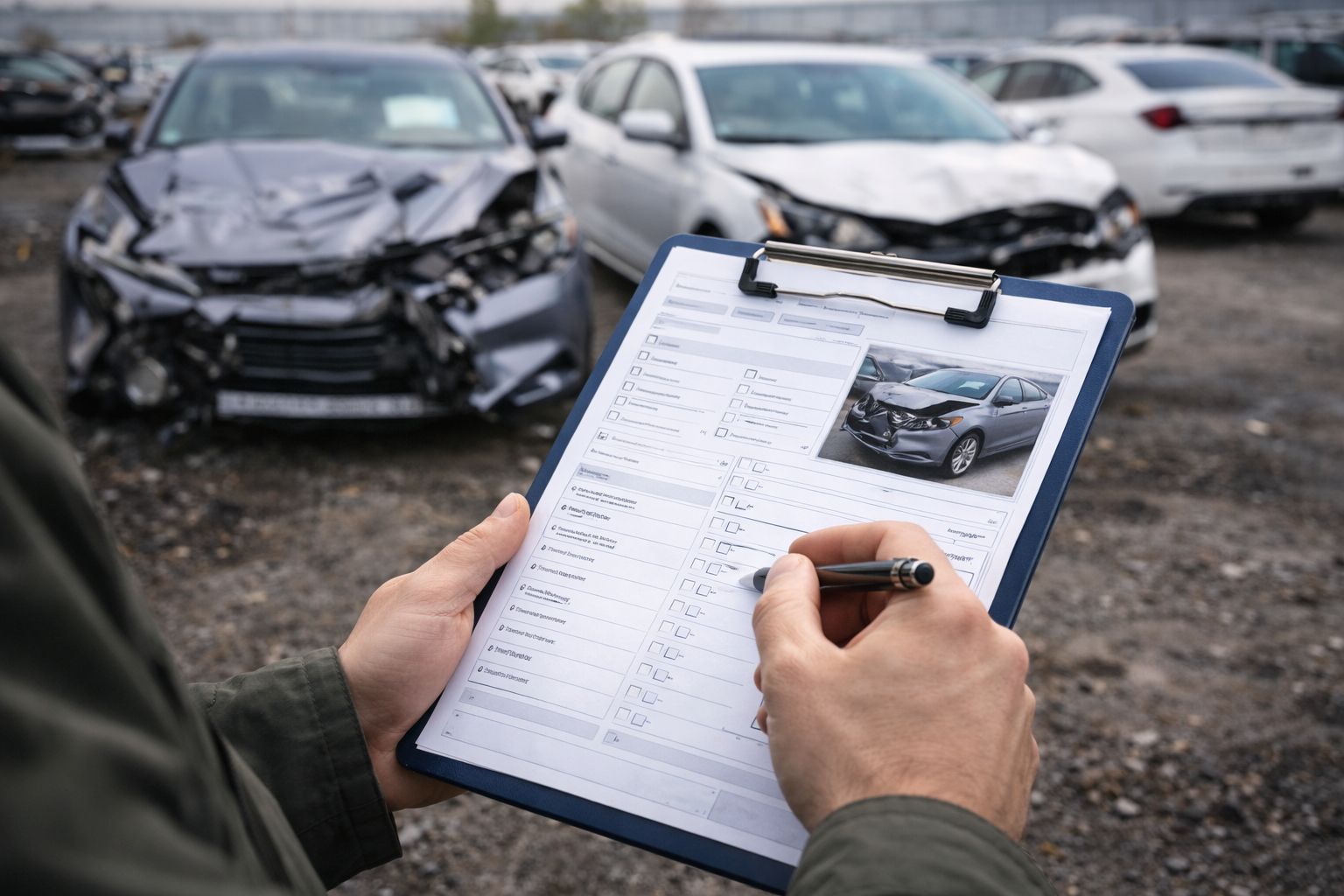
Next, we'll examine each of these levels separately. Within each group, we'll provide a reference table and cards for individual statuses. Now you'll be able to do more than just memorize the names; you'll also get a professional interpretation of how these values work together.
Group 1: Lot statuses that we recommend as a basic format for importing cars from the United States
When we say "recommended," we don't mean the absence of damage or repairs. In our context, it means that importing a car from America is generally predictable .
Reference table: statuses with high manageability
|
Status |
What is this status about? |
Seller's terms and conditions |
What changes for the buyer |
Why in group 1 |
|
Run and Drive / Run & Drive |
The technical capability of the vehicle to start and move at the time of acceptance |
— |
starting assessment for the technical part |
You can plan the main stages of the renovation |
|
Pure Sale |
Transaction format |
No |
The deal is going ahead without any additional approvals. |
Fewer variables in the purchasing process |
|
Eligible / Ready for Sale |
Lot readiness for auction |
— |
The lot is approved and can be sold without delays |
Stable stage within the auction |
|
On Minimum Bid / No Minimum |
Pricing rules |
Not really |
Affects the trading strategy and the final price |
Does not affect the legal route of delivery |
Brief explanations:
- A Pure Sale means the seller has no additional conditions. The sale proceeds as a direct transaction, with no post-bid "confirmation" steps.
- Eligible / Ready for Sale refers to the lot's readiness to participate in the auction, not the car's condition.
- On Minimum Bid / No Minimum — this refers to the presence or absence of a minimum starting price for the seller. This setting affects the bidding process and the final purchase price, but does not describe the vehicle's specifications or documentation.
Status Card: Run and Drive / Run & Drive
What does Run and Drive mean?
This status indicates that the vehicle was capable of starting and driving upon arrival at the auction site. " Run and Drive" literally means "starts and drives." The vehicle enters and exits the tow truck and can be driven around the auction site. In the auction system, this status indicates the vehicle's basic functionality, indicating that the engine starts and the main electronics are operational. However, please note that it only confirms that the vehicle was in working order upon arrival.
What Run and Drive status doesn't guarantee
- absence of hidden defects;
- serviceability of the gearbox under load;
- correct operation of electronics after repair;
- no internal engine damage.
An auction inspection is a functional minimum, not a technical assessment. Today, this additional service can be performed by our partners directly at the auction site.
Acars position
In most cases, we consider Run & Drive as the base format for most projects. In our experience, these are cars with body damage, signs of accidents, or varying degrees of wear, but with the basic mechanics intact. While they may look different visually, they all share the same basic principle: the car remains "live" as a means of transportation.
However, we refuse to accept the vehicle even with this status if the lot's associated parameters, such as the title, indicate legal restrictions, non-standard sales conditions, or if we see signs of a threat to proper logistics. The status itself is not a license, but merely a foundation for further analysis of the vehicle.

Group 2: Conditionally acceptable statuses when importing a car from America
These statuses take the project beyond the "default" zone. Formally, the import remains feasible, but its nature partially changes, introducing more risk. Additional variables appear in the chain: timing, transaction confirmations, and the actual technical condition of the vehicle, which cannot be resolved solely through a formal analysis of the lot. Importing such a car from the US will only be profitable if all additional factors are thoroughly considered in advance.
Reference table: statuses with conditional controllability
|
Status |
What is this status about? |
Seller's terms and conditions |
What changes for the buyer |
Why in group 2 |
|
Enhanced Vehicles |
Preparing a lot for resale at auction |
— |
It is more difficult to assess the actual extent of damage, as the reason for the modifications is not obvious. |
Often hides complex defects covered by temporary repairs |
|
Engine Start Program |
Checking engine starting |
— |
Launch confirmed, but no movement |
Narrow test ≠ overall performance of the mechanical part of the car |
|
Pending Sale |
Waiting for the auction results |
Yes |
Seller cancellation or delay possible |
Winning the auction does not guarantee the possibility of redemption. |
|
Vehicle on Approval / Seller Approval Required |
Confirmation format |
Yes |
The sale depends on the seller's decision |
Loss of control over deadlines |
Brief explanations:
- A pending sale means the item is in an intermediate stage after the auction and has not yet reached the final sale stage. The transaction may be confirmed or cancelled.
- Vehicle on Approval / Seller Approval Required - indicates that the sale outcome is dependent on the seller's discretion. Even winning the bid does not guarantee completion of the transaction.
Status Card: Enhanced Vehicles
What does Enhanced Vehicles mean?
In the Copart interface, this marker indicates lots that have undergone additional processing or preparation at the auction site before being relisted. Enhanced Vehicles literally translates as "improved vehicle." In reality, this doesn't refer to the quality of the car, but rather to the fact that the auction has modified the information on the lot page:
- photographs are updated (new, more informative or accurate ones are taken) mainly because the lot has not been sold for a long time;
- the description of damage is corrected;
- The status data is being clarified.
Sometimes a car is brought into a more presentable condition (this is permitted by the car's status). Dirt is washed off, cosmetic signs of an accident are removed, attachments are aligned or secured, minor exterior parts (headlights, mirrors, bumpers) may be replaced, and the geometry of attachments may be adjusted to make the car look more expensive.
In other words, Copart enhanced vehicles are cars whose appearance has been partially restored to a more presentable condition, but this is not a full repair and does not mean that they are technically sound again.
Enhanced vehicles: damage
In Acars.ua's practice, the most common reasons for enhanced vehicle status are:
- cars after an accident with a cosmetically restored body;
- lots in which traces of deformation are hidden or smoothed out;
- cars with masked gaps, traces of local straightening and repainting;
- cars with unrepaired internal damage but improved external appearance.
Acars' Position: Enhanced Vehicles - Is It Worth Buying a US Car?
Short answer: Possibly, but only with extensive and professional verification.
We view enhanced vehicles as projects with a higher risk of unexpected repair costs. These lots are almost always very attractively priced, but as we know, there's no such thing as a free lunch. Therefore, we only work with them after a thorough technical inspection and the buyer's willingness to accept discrepancies between the vehicle's appearance and its actual technical condition. Without understanding this context, the lot shifts from a predictable to a conditional one.
Status Card: Engine Start Program
What does Engine Start Program mean?
This status bar entry indicates that an attempt was made to start the engine on the auction site and it started. Please note that the system only records the engine starting. It differs from the Run and Drive status in that it does not record any movement under its own power. The car starts, but will not start due to problems with the transmission, chassis, lockups, or other technical limitations.
The Engine Start Program (ESP) is a translation of the "engine start program," which confirms only one level of engine performance. It's an intermediate marker between "unknown" and "functioning while driving."
The presence of the engine start program means
- the engine starts;
- the battery and basic ignition system are functioning;
- The status does not confirm the vehicle's ability to move under its own power.
Acars' Position: Engine Start Program – Is It Worth Buying ?
The short answer is: it's possible, but only as a project with a high degree of unknowns or for dismantling the car for spare parts.
Group 3: Legally closed statuses where importing a car from the USA is not possible
This group encompasses statuses under which a project may formally appear "purchasable," but in reality, it reaches a legal impasse. The issue here isn't the extent of damage or the repair budget, but the legal status of the vehicle itself. Even if seemingly intact, such lots cannot be legally registered as vehicles in Ukraine, because their very status negates their legal existence as vehicles.
In practice, it's this category that most often becomes a source of illusion for buyers: "cheap," "almost intact," "can be restored." But this status preemptively blocks registration, operation, and full import.
Reference table: statuses with zero import capabilities
|
Status |
What is this status about? |
Seller's terms and conditions |
What changes for the buyer |
Why is there 3 in group? |
|
Parts Only |
The car is sold exclusively for spare parts. |
— |
Registration is not possible |
Legally it is not a vehicle |
|
Junk |
Complete recycling |
— |
Ban on restoration |
Withdrawn from circulation |
|
Certificate of Destruction |
Certificate of Destruction |
— |
Export and registration are prohibited. |
The car cannot be returned to legal circulation as a means of transport |
|
Export Prohibited / Non-Export |
Export restrictions |
Yes |
Cannot be legally exported from the US |
Blocks the drive |
Acars' position: why we don't work with these statuses
We don't accept projects with these statuses on principle. They don't lead to a car with Ukrainian license plates. Even with perfect repairs and significant investment, you won't be able to legally register the car as a vehicle.
How to Make a Decision When Sorting Lots When the Status Contains Multiple Values: A Cars' Practical Checklist
We use a simple, practical principle and evaluate not only the car, but also the potential for successful implementation of the entire project. Therefore, we evaluate the lot based on the most stringent status in the bundle, and not the most "pretty."
Below is a checklist that allows you to quickly filter out dangerous options.
Step 1. Check for statuses from group 3
If the status includes "Parts Only," "Junk," "Certificate of Destruction," or "Export Prohibited" or "Non-Export," the lot is immediately excluded. No other values (including "Run and Drive ," "Eligible," or "Pure Sale") will compensate for this. A legal prohibition overrides any technical criteria.
Step 2: Determine if there are statuses from group 2
If at least one status from group 2 is present ( Enhanced Vehicles, Engine Start Program , Pending Sale, Vehicle on Approval / Seller Approval Required) → the project acquires additional conditions.
The following are required here:
- extended verification;
- budget reserve;
- readiness for discrepancies between appearance and reality;
- understanding of possible delays or cancellation of the transaction.
Step 3. Assess the presence of group 1 statuses
Statuses like Run and Drive, Pure Sale, Eligible / Ready for Sale, and No Minimum form the standard delivery process. This type of lot can be considered a starter project, but it's too early to consider it a fully guaranteed vehicle. These values indicate the stage of the process, not the quality of the car.
Acars' final position on handling vehicle statuses at US auctions
The car can be restored. The status cannot. It either leads to Ukrainian license plates or ends the journey before it even begins. The Status line is a project map, showing one of the profitability ranges for the entire transaction.
A legal ban immediately terminates this route. Additional conditions increase its risk, which directly impacts the final deal budget. Therefore, we apply the strict comprehensive status rule, because the Status almost always displays a set of values.
Some typical examples from practice:
- Run and Drive + Parts Only → technically a "live" car, legally dead. We are not considering this item further.
- Pure Sale + Certificate of Destruction → a clean deal in form, meaningless in outcome. We are not considering the lot further.
- Eligible + Export Prohibited → the item is ready for bidding but is blocked from export. We are not considering this item further.
- Run and Drive + Enhanced Vehicles → The vehicle is in working order with a high probability of hidden defects under the cosmetics. Acceptable only with a comprehensive inspection and sufficient budget.
- Engine Start Program + Pending Sale → the engine starts, but the project itself may not materialize. We consider such lots only as conditional projects with a high degree of uncertainty.
- No Minimum + Seller Approval Required → The price may be attractive, but you have no control over the transaction. We recommend not considering this item further.
If a comprehensive status analysis does not result in the registration, operation, or actual ownership of the vehicle in Ukraine, such a lot is not a project.
FAQ
Why does the status sometimes contradict the photo and description?
For example, it says Run and Drive , but the photo shows serious damage.
The status records the minimum functional fact at the moment of acceptance at the lot: the car started and was able to drive. A photo is a visual snapshot of the body's condition. These two layers of lot characteristics describe different things and do not necessarily match in terms of "feel." A car can drive and still look like it has been in a serious accident. The status does not evaluate the aesthetics or the extent of damage. It only records basic functionality.
What is more dangerous: bad status or bad title?
A bad title kills a car legally.
Bad status kills the project procedurally.
Both are equally critical, but operate at different levels. The title determines whether a car can exist as a means of transport. The status determines whether the deal can even be finalized. One ends the process at the legal level, the other at the process level. Either one renders the project unviable.
Why does the auction use such abstract statuses?
Because status is the language of the auction's internal logistics, not a service for buyers. It was created for the platform's operators to understand where a lot is in the sales chain, what actions are possible with it, and what processes are running. These are operational system markers, not user hints. Buyers see them as a "code" because they weren't intended for retail use.
Is it possible to determine, based on the status, how much will actually need to be invested in repairs?
No. This is a dangerous myth.
The status answers the question: "Can the project be completed?" It doesn't answer the question: "How much will it cost? "
Run and Drive doesn't mean cheap repairs. The Engine Start Program doesn't specify a specific scope of work. The budget is determined by damage, geometry, hidden defects, and the vehicle's components—things the program doesn't describe. It only indicates whether the repair is feasible. It doesn't determine the cost.